

building confidence trading options | Outlier Insights
Welcome to Outlier Insights!
There are three main sections:
Announcements to stay up to date with the latest in the Outlier Trading community
Market Analysis is where I share 15 high summary points for the market from the week prior.
Erik’s Brainstorming is where I share a couple ideas to watch each week along with my perspectives; often market related, sometimes not.
If what I do helps you out please share.
Be an Outlier!
-Erik
Announcements
Outlier Community Updates:
Outlier Pros can check out the weekly schedule of events below, with streams set for Sunday (Market Prep), Tuesday (Market Internals), and Thursday (Skill Development). https://www.patreon.com/posts
Outlier Pro Plus Zoom workshops are the first and third Monday each month at 5pm PT! https://www.patreon.com/OutlierTrading
Next session is 6 Oct!
Links.
Outlier Trading YouTube Channel - Daily livestreams & Weekly videos every Sunday.
FREE Outlier Community - Join like minded traders, education, & information.
Outlier Pro Patreon - Ready to transform your trading? Build for options traders of ANY skill level.
Latest videos below: https://www.youtube.com/@OutlierTrading/videos
1. Market Analysis.
Index Performances: The S&P 500 notched a record closing high to cap the week, reflecting broad market resilience despite intraday swings, while the Nasdaq Composite edged lower on Friday but still posted weekly gains driven by tech sector momentum; the Russell 2000 advanced, highlighting strength in small-cap stocks as investors rotated toward value plays.
Volatility Trends: VIX experienced moderate fluctuations throughout the week, settling in the mid-teens range by Friday, signaling subdued but persistent uncertainty that could favor options strategies like straddles for hedging against potential policy disruptions.
Commodities Overview: Precious metals and energy showed divergent paths, with safe-haven demand bolstering gold while crude oil faced pressure from supply dynamics, underscoring opportunities in commodity-linked options for volatility plays amid global economic signals.
Gold Performance: Gold futures climbed steadily, reaching new highs above $3,880 per ounce by week’s end, buoyed by inflation hedging and geopolitical tensions, presenting bullish call option setups for traders eyeing continued upward momentum.
Crude Oil and Bitcoin: Crude oil prices declined amid OPEC+ production adjustments and softer demand outlooks, dipping toward $60 per barrel and opening put option appeal for energy sector exposure; meanwhile, Bitcoin surged past $122,000, fueled by “Uptober” rally hype and ETF inflows, igniting speculative call buying in crypto derivatives.
Sector Highlights: Healthcare led sector gains with robust advances tied to positive earnings beats and M&A buzz, while utilities provided defensive support; technology held firm but showed rotation risks, and consumer discretionary lagged, suggesting sector-specific straddles to capture earnings volatility next week.
Notable Stock News: Tron Inc. shares jumped following a record earnings report, spotlighting growth in digital infrastructure; analyst upgrades targeted Johnson & Johnson and PayPal for defensive and fintech upside, while S&P 500 earnings growth is projected to moderate but exceed estimates, priming the market for post-earnings options flows.
US Economic Developments: A government shutdown disrupted key data releases, including the September jobs report, leaving economists to rely on private indicators like ADP’s signal of 32,000 job losses—contrary to expectations—and hinting at labor market softening that could amplify implied volatility in rate-sensitive options.
Fed and Inflation Context: With official inflation and employment figures delayed, the Federal Reserve faces a data blackout, yet markets maintain expectations for potential rate cuts if private surveys confirm cooling; this opacity boosts the appeal of VIX calls as traders position for policy surprises in upcoming FOMC minutes.
Global Market Influences: Geopolitical strains, including OPEC+ maneuvers and China’s investment stimulus plans worth $70 billion, added layers of uncertainty to energy and trade flows, while elevated risks from cyber threats and economic slowdowns in emerging markets reinforce the case for diversified global ETF options to navigate cross-border volatility.
Looking to make serious progress as a trader without the BS? Join the Outlier community to accelerate your learning curve and develop your trading skillset. What members say:
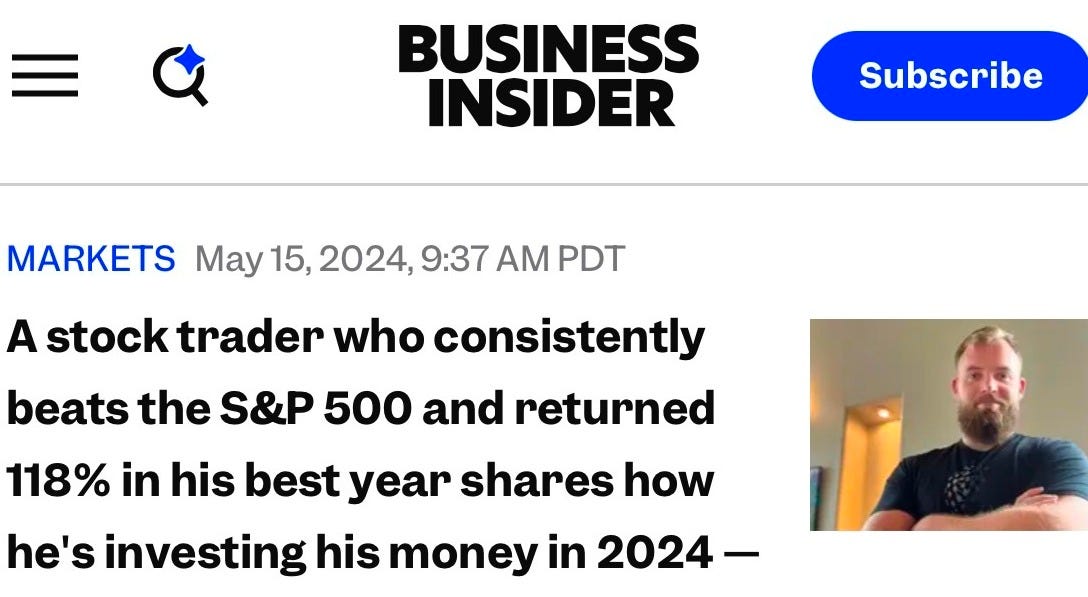
““I’ve spent thousands on courses and alerts over the years, but nothing ever clicked like this. Erik rewired how I think. For the first time, I understand volatility, risk, and why trades work. I’m finally trading with confidence instead of guessing.”
-James K.
2. Erik’s Brainstorming.
You are told that you need to be confident to create success as a trader. While accurate, it misses the most important aspects of the concept.
Why confidence matters?
Our ability to repeatedly execute a strategy is essential to our long-term performance. For example, if you trade short vol through earnings to capture variance risk premiums, there will be many losing trades. Sometimes, many in a row. However, we know the effect has efficacy in the long-run. Yet, our ability to achieve the expected returns requires our ability to continue trading the strategy - even if there are losing periods.
Another common issue traders face is strategy hopping. Following the example above, it’s extremely common for new options traders to trade something and as they go through a losing period, to believe the strategy they’re using is no longer valid and to jump to something else. This is unequivocally the wrong answer. Strategies will all go through winning and losing periods, this is known as path.
Be confident!
Confidence is not something that can be willed. It’s not something we can fake. Confidence comes from practical application. It comes from seeing the output of a demonstrable skillset with satisfactory results.
So then in trading, how can we build confidence if it requires application of a skillset we might not have? There are several ways:
Research. By building a knowledge base we inherently begin to grow in confidence. Learning the fundamentals of trading will move us a long way. One of my BIGGEST recommendations here is as you learn, have ChatGPT create quizzes for you (example prompt: “I am a self directed retail trader that operates at a professional level. I just learned about BLANK. Create a 25 question quiz to test my knowledge. 15 questions multiple choice. 5 questions short answer. 5 questions long answer. Create an answer key but do NOT show me until I ask for it”). You can also leverage free courses online through your broker, practice Series X exams, and college open courses (like MIT OCW).
Papertrade. Papertrading will NEVER replace the full effects of live trading. However, it is the first step towards the experience and allows us to draw a lot of learning. We can amplify the utility if we mentally frame our papertrading as if it is truly our real capital. This is similar to training in the military. We don’t actively shoot one another for us to take it seriously. We learn a lot in training but it never fully replaces the experience of actual warfare against true enemies that are trying to kill you. I in no world would want to deploy with Marines that didn’t train simply because it wasn’t the real thing. Same concept in trading. While papertrading, it’s KEY that you track your performance in a trade log to be able to analyze, observe, and adjust. This data driven optimization adds another layer of confidence vs us taking guesses or taking something we heard and trying to employ that.
Test live. The beginning stages of a new strategy or trading for a new options trader should be sized at the absolute minimum viable size. Most of us start trading with the idea of markets providing fast easy money, this simply is not and will never be the case. The sooner you accept this and shift your focus from the outcome of your individual trades to the process of building positively expectant robust strategies that will last you a lifetime, you’ll learn to full appreciate this step. Here, you can also calculate the number of trades you need to make in order to attain a BLANK confidence interval that the results you’re seeing are reflective of the true performance of the strategy. [((1.645 * Std Dev) / ER )^2] 1.645 z-score represents a 95% confidence interval on a one tailed test. 2.33 is 99% FYI.
Recap. The process of building confidence simply comes down to doing the work, making the adjustments, and monitoring the results. Each step in this process from researching the basics of markets, to researching profit mechanism, signals, strategies, etc to conducting thorough AARs (after action reviews) to assess our performance ultimately yield true confidence.
One HUGE cautionary tale. First, westerners (which I am one) are NOTORIOUS for overestimating their skill level in general. Next, add on the Dunning Kruger effect, where as we spend hundreds of hours learning, we hit a crucial phase where we know enough to hurt ourselves but still don’t know what we don’t know. A friendly reminder on the general “mastery” threshold of 10,000 hours represents spending 5 hours every single day for 5.5 years straight without ever missing a day. The point there isn’t to dishearten you, it will come in time. It’s to caution you away from the Skill Gap Peak, where we tend to make the largest mistakes.
Confidence ultimately comes from competence. Take the time to build it so it’s truly there. You cannot fake it.
Good luck out there.
Be an Outlier
Erik
DISCLAIMER:
The content presented is for informational purposes only and any opinions, news, research, analyses, or other information contained are provided as general market commentary and do not constitute investment advice. Outlier Trading, its affiliates, and employees are not responsible for any investment decisions made based on the information presented. We do not guarantee the accuracy, completeness, or reliability of any information presented and are not liable for any losses or damages arising from the use of or reliance on this information. By accessing this content, you acknowledge and agree to these disclosures and terms of use.